Because Mondays are MURDER...
Showing posts with label crime of passion. Show all posts

Monday, 14 January 2013

Murderous Monday - Men Who Kill - John Hannah - The Armley Murder


On Saturday 27th December 1856 at York Castle, John Hannah a tailor from Manchester, met his maker at the end of Thomas Askern's rope for the wilful murder of his common law wife Jane Banham.

John Hannah was born sometime in 1836 in Ireland to William Hannah, a tailor and his wife Lelia.  John was one of nine children born to his parents.  On the 1851 Census, 15 year old John can be found living with his parents and siblings at 11 Warriners Buildings, Bishopsgate, Manchester.

At some time after March 1851 John started a relationship with Jane Banham, a married woman ten years his senior.  Jane Banham, a dancer in a travelling corps of performers, and her children had been abandoned by her husband William when he emigrated to America.  She began to live with together with John as husband and wife, baring him two children.  However things between them began to sour.

Two weeks before the Christmas of 1855 Jane and John separated.  Jane took the children to live with her father John Hope, a member of the same performing troupe.  In the June of 1856 the company were performing in Halifax.  John Hannah walked to Halifax from Manchester and pleaded with Jane's father to be able to speak with her.  At first John Hope refused but John Hannah persisted until a meeting was set up between them back in Armley at in the parlour room of the Malt Hill Inn on 11th September.

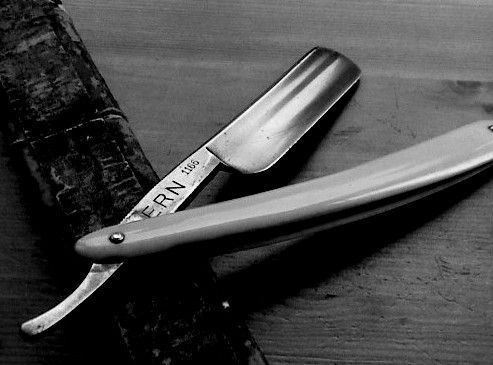
During this meeting John Hannah pleaded with Jane to return to him with the children, upon her refusal John asked Jane's father to speak to her on his behalf.  John Hope was reported to have said that he would, 'have nothing to do with the matter.'  John Hope left John Hannah and his daughter Jane still talking in the Malt Mill Inn.  Witnesses reported that at one point Jane left the Inn saying, 'I want nothing more to do with you!'  It was at this point that John Hannah pulled Jane back into the parlour room.  A little while later the scuffing of chairs was heard in the parlour, causing the landlady of the Inn and some patrons to investigate.  They found John Hannah kneeling upon Jane grasping her throat tightly with his hand.  One of the witnesses exclaimed, 'what do you mean, you rascal!'  To which John replied, 'I mean murder,' before slitting Jane's throat with a razor.  He then calmly got up and left the inn saying, 'I have done what I intended.'

Poor Jane staggered from the inn into the street, streaming blood from her neck.  She was taken to her lodgings and medical assistance was sort.  Sadly Jane passed away two hours later.  Doctors remarked that it was a miracle she lived so long.  John was soon found, arrested and brought to trial at York assizes on 13th December before Justice Erle.  John's defence relied heavily on the suggestion that this was a case of aggravated manslaughter rather than murder due to Jane's provocation of John.  Justice Erle stated that he could not find anything that was provocation by blows, and it was his opinion that Jane's refusal to live with John was not provocation at all.

The jury retired and a mere 15 minutes later found John guilty of the charge of wilful murder.  Upon hearing the death sentence John fainted and had to be helped from the court.

John Hannah's father, William Hannah sent a letter to Queen Victoria pleading for John's life to be spared.

"To Her Gracious Magesty,

Manchester, December 17th 1856.

This is the humble pettion of William Hannah to Your Gracious Magesty, praying that you will spare the life of my unfortunate son, John Hannah, that is now lying in York Castle under the sentence of deth, for the murder of Jane Banham, at Amrley, on 11th September.  Your humble pettioner served in the Royal Artilrey for twenty years, and was at the taking of the Flushing, in 1809 and shortly after joined Lord Wellingtons Armay, whare i was engaged in the prinsebel ingagmanets in that contary; and for my service your most Gracious Magesty granted me a shilling a day and a medal with six clasps; i also lost a son in the Canidian war, fighting against the rebels.

My unhappy son's twin brother as lastly been discharged from the 7th Royal Fusiliers at Chatham, with a pension of 8d. per day.  He landed in the Crimea with the expedton, and fought with his reghment at the Alma, and at the Battel of Inkerman, and was severely wounded in the assult of the  Grait Redan, and was presented with a medal and three clasps from your most Gracious Magesty.  i also have a nother son that is following in the steps of his father and two brothers; he is serving in the 5th Royal Lancashire Militia.  Your humbel pettioner hopes that your most Gracious Magesty will take it into your consideration the service that this familey has doen for thare Queen and contary, and spare the life of my unfortunate son, for my sake and that of his poor mother, that was with me through the Peninsular War.  This is the humble and sincere wish of your humble and faithful servant, and father of my unfortunate son, William Hannah.'

Sadly the Hannah family's military service was not enough to save John from his appointment with Thomas Askern.

The execution took place at noon, some 5000 spectators turned out to watch the hanging.  The bolt was drawn, John dropped and after a few struggles, fell still.  John's body was left hanging until 1 o'clock when it was cut down and taken for burial in the castle grounds.


Monday, 17 December 2012

Murderous Monday - Women Who Kill - Mary Eleanor Wheeler Pearcey, Jealous Lover?


"London's Newest Tragedy."
 
"Two Murders by Mary Wheeler In A Fit Of Jealousy."


On 23rd December 1890, Mary Eleanor Wheeler Pearcey met her maker at the end of James Berry's rope at Newgate Prison, London.  She had been convicted of the murder of her lover Frank Hogg's wife Phoebe and baby daughter Phoebe Hanslope Hogg.

Mary Eleanor was born Mary Eleanor Wheeler on 26th March 1866 in Inhtam Kent to James Wheeler, a delivery foreman and Charlotte Ann Kennedy.

Note: there are many references online to Mary Eleanor Wheeler being the daughter of Thomas Wheeler, the famed murderer of Edward Anstee. This is not true and has been proven definitively from direct testimony given by Charlotte Ann in the consequent murder trial of her daughter, Mary Eleanor.

On the 1881 Census, 15 year old Mary is shown living with her parents at 16 Maroon Street, London.  However, Mary's father James was to die on 17th August 1882, his death greatly affected Mary and three months later she tried to commit suicide by hanging herself in the garden, from the nail the washing line was attached to.

Around the age of 18 whilst working at a seal skin factory, Mary met and befriended John Charles Pearcey a carpenter, soon after they were living together as man and wife, with Mary calling herself Mrs Pearcey.


"When I made her acquaintance I knew her as Eleanor Wheeler, after an acquaintance of three or four months she lived with me.  I lived at different places, and eventually at Bayham Street, Camden Town.  I lived with her about three years, when I ceased to live with her she remained at Bayham Street when she lived with me she took the name of Pearcey, and afterwards passed in that name" - John Charles Pearcey at Mary's trial.


They seemed happy, that was until the arrival of Frank Hogg.  Frank Samuel Hogg was born In Pancras London in 1860 to James a grocer and tea dealer and Maria Hogg nee Hanslope.  When friendship blossomed between Frank and Mary he was working at his then widowed mother's grocery shop at 87 King Street, Camden Town.  It wasn't long before their 'friendship' started to sour Mary's relationship with John.


"Towards the latter part of the time she made the acquaintance of Mr. Hogg, and I saw her from time to time in company with Hogg, frequently in the shop in King Street, in consequence of that I ceased to live with her."

"After I ceased to live with the prisoner, I saw her from time to time, and spoke to her.  I simply passed the time of day, I never visited her.  I was told she she had removed from Bayham Street to Priory Street." - John Charles Pearcey at Mary's trial.
 
At some point Mary gave Frank a latch key to her door at 2 Priory Street so that he could come and go as he pleased.  However there was soon to be a thorn in the side of Mary's happiness.  In 1888 Frank married Phoebe Styles who was pregnant by him, their daughter Phoebe Hanslope Hogg, affectionately known as Tiggy, being born in 1889.  At first Frank had wanted to avoid the marriage, considering both leaving the country and suicide to do so.  Through letters Mary had managed to change his mind and convince he to accept his responsibilities. 


2nd October 1888
My dear F,  Do not think of going away, for my heart will break if you do; don’t go , dear. I won’t talk too much, only to see you for five minutes when you can get away; but if you go quite away, how do you think I can live? I would see you married fifty times over, yes. I could bear that far better than parting with you for ever, and that is what it would be if you went out of England. My dear loving F, you was so down-hearted to-day that your words give me much pain for I have only one true friend I can trust to, and that is yourself. Don’t take that from me. What good would your friendship be then with you so far away? No, no, you must not go away. My heart throbs with pain only thinking about it. What would it be if you went? I should die. And if you love me as you say you do, you will stay. Write or come soon, dear. Have I asked too much?  From your loving, M. E.

P.S.  I hope you got home safe, and things are all right, and you are well.  M.E.


18th November 1888
Dearest Frank,  I cannot sleep, so am going to write you a long letter. When you read this I hope your head will be much better, dear. I can’t bear to see you like you were this evening. Try not to give way. Try to be brave, dear, for things will come right in the end. I know things look dark now, but it is always the darkest hour before the dawn. You said this evening, “I don’t know what I ask.” But I do know. Why should you want to take your life because you want to have everything your own way? So you think you will take that which no man has a right? Never take that which you cannot give you will not if you love me as you say you do. Oh, Frank, I should not like to think I was the cause of all your troubles, and yet you make me think so. What can I do? I love you with all my heart, and I will love her because she will belong to you. Yes, I will come and see you both if you wish it. So, dear, try and be strong, as strong as me, for a man should be stronger than a woman. Shall I see you on Wednesday about two o’clock? Try and get away, too, on Friday, as I want to know if you are off on Sunday till seven o’clock. Write me a little note in answer to this. I shall be down on Monday or Tuesday in the morning, about 5 a.m. So believe me your most loving, M.E.
Mrs. Phoebe Hogg

Mary befriended Phoebe, inviting her and Frank to spend Christmas and Boxing day with her at 2 Priory Street in 1889.  Phoebe became ill in the February 1890 and it was Mary that nursed her during that time.  It was around this time that Frank had his own concerns about his wife's fidelity and an argument ensued that stopped Mary from visiting Frank.  However Mary continued her friendship, both with Frank's sister Clara Hogg and his wife Phoebe.

It was on the 23rd October 1890 that Mary paid Clara a visit for the last time, it was after this visit that Mary invited Phoebe to have tea with her at her home the next day at 4:00pm

The New York Times reported -


"About 3 o'clock P.M. of Oct 24, the luckless woman left her home, taking her child with her in a perambulator, and was never thereafter seen alive by nay of her relatives.  Next day her sister-in-law, still in ignorance of her death, called upon Mary Wheeler to inquire [sic] if she had seen 'Phee' and received an answer in the affirmative."


Mary was still with Clara, explaining how she had, 'scratched her hands and smeared her dresser with blood killing mice', when news was received that the body of a murdered woman had been found in Hampstead.

The corpse was found to have a fractured skull as well as extensive bruising around the head and forearms, the neck had also been cut so violently that the head was almost severed from the body.

Clara asked Mary to accompany her to the mortuary in order to see whether the remains where that of the missing Phoebe.  It was Mary's bizarre behaviour when confronted with the corpse of her victim that raised suspicions of the police and resulted in a search of her home at 2 Priory Street.  The discovery of blood stains on the walls and kitchen door as well as on the clothes worn by Mary resulted in her arrest.

Later that evening whilst on his rounds, a police constable discovered a heavily bloodstained perambulator in Hamilton Terrace, a mile from where Phoebe's body had been discovered, yet little Phoebe was still missing.  The next morning little Phoebe's unmarked body was discovered, it was believed that she had died from suffocation either during her mother's murder or soon after.

The New York Times continued -


"according to the theory set up by the surgical witnesses respecting the manner in which the crime was committed, Phoebe Hogg, upon entering the kitchen, was struck down from behind by a heavy blow, inflicted by a poker upon the back of her head, and fell upon the floor in "terrible convulsions".  While struggling for her life, she received three more blows, which probably stunned her, whereupon the murderess to "make sure," all but severed her victim's head from the body with three several [sic] cuts of a knife.  It is assumed that she then strangled the child, packed the two corpses into Phoebe Hogg's own perambulator, and wheeled them off to the places where they were subsequently found lying dead."


Two separate witnesses recalled having seen Mary pushing a 'heavily laiden' perambulator between the hours of 6 and 7 the previous evening.  The search earlier conducted by the police at 2 Priory Street turned up a metal button missing from the jacket of Phoebe Hogg.  Also a cardigan indentified as belonging to Mary was found wrapped around murdered Phoebe's head.

Mary was sent to trail at The Old Bailey on 1st December 1890.  The trail lasted for three days in which many witnesses were called and Mary's letters to Frank read out.  Mary gave no evidence at the trail, yet maintained he innocence with a plea of, 'not guilty'.  Unfortunately for Mary the Jury did not share her feelings and after only 52 minutes found her guilty of the murders of Mrs Hogg and her baby.  Before her sentence was read out Mary was asked if she had anything to add, Mary simply stated, 'I say that I am innocent of this charge.'

The execution happened on the morning of Tuesday 23rd December 1890, carried out by James Berry.  When asked by the Sheriff of London, Sir James Whitehead, if she had any final remarks Mary uttered, 'my sentence is a just one, but much of the evidence against me false.'


Picture of Mary Eleanor Wheeler-Pearcey's
wax work once housed in the chamber of horrors.